GEO
How to get your business recommended by ChatGPT
ChatGPT names the businesses its sources agree on. Let it read your site, describe yourself consistently and get mentioned. Google rankings help, but aren't needed.

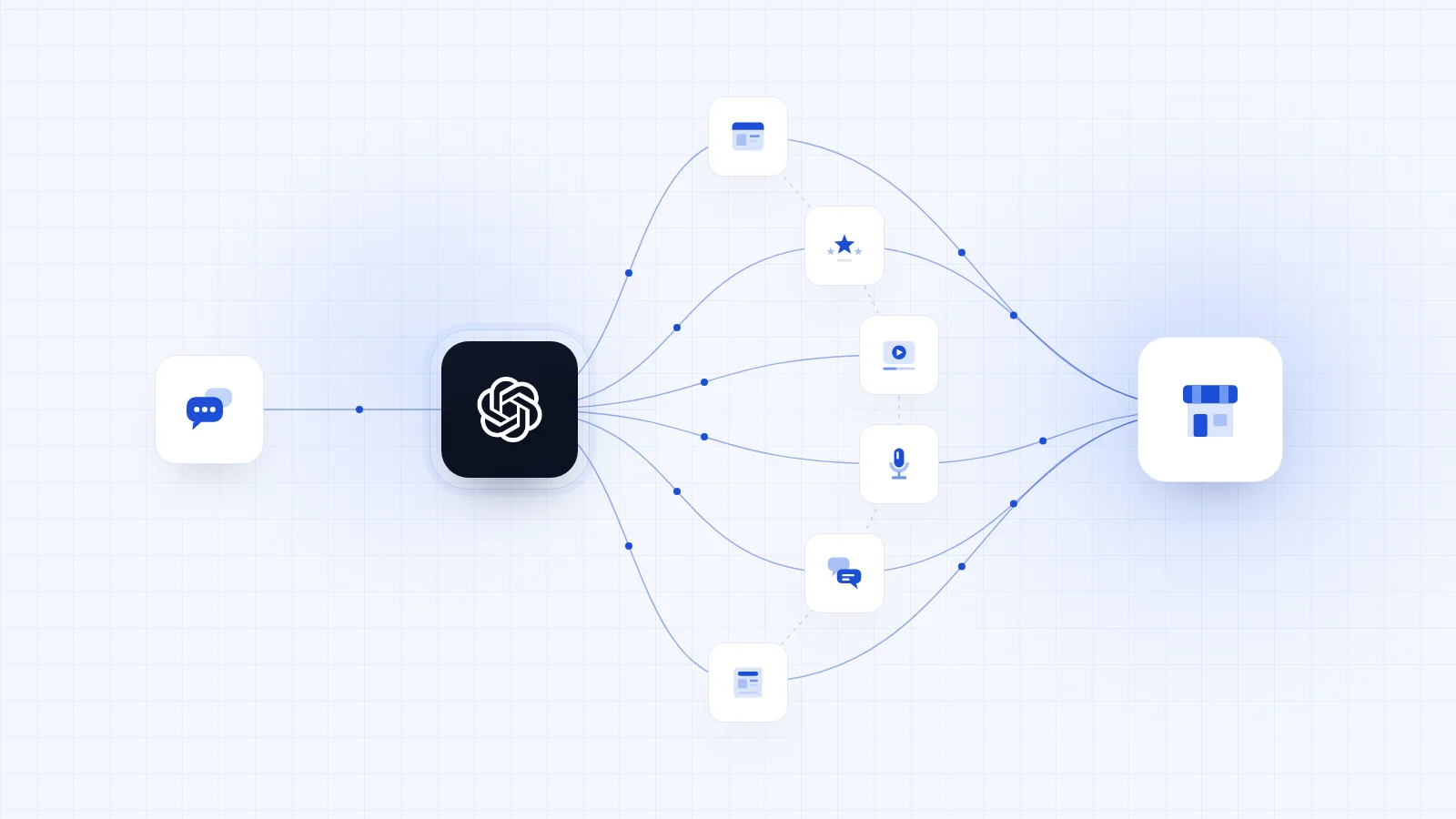
ChatGPT checks what it already knows against a live web search, and names the businesses that come up consistently and clearly across the sources it finds. So the place to start is a few basics: making sure it can read your site, describing what you do the same way every time, getting other people to mention you, and publishing content that answers questions directly.
How does ChatGPT decide which business to name?
It works from two sets of information: what it learned in training, which is usually not very recent, and what it finds when it searches the web while answering.
It also weighs reputation, which is very similar to domain authority in SEO, a measure of how far the rest of the web trusts a site. ChatGPT leans towards businesses that plenty of other sources agree on. SEO used to chase that with links from high-authority websites. Links matter less now, but the idea is the same, and most businesses can't influence it directly without big budgets or incredible networks.
Web search is the part you can influence directly. Where a person types one phrase into Google, ChatGPT runs several searches behind the scenes, each worded a different way. These are called fan-out queries. A study published in August 2026 found it runs about eight for every question on average, and up to 29. It merges what comes back, pulls short passages from a range of pages (never a whole page), and cross-checks them against what other sources agree on. The businesses it names are the ones several independent sources back up. If you write ten pages about yourself, that's still only one source.
Think of it like thisSay you ask a well-read friend who fought which countries in World War 2. They have a rough idea, but you both like to be right, so they do a quick search, see what most sources agree on, and come back with the answer. ChatGPT works in much the same way.
Each AI tool has its own favourite sources, too. ChatGPT's searches lean heavily on Bing, Microsoft's search engine, and it has cited forums like Reddit a lot, though how much changes from month to month. So if you do well in Bing search results, your chances of being cited in ChatGPT are technically higher than if you're only doing well on Google alone.
Is being used as a source the same as being recommended?
No, and it's the part most worth remembering. Everything ChatGPT tells a user is built from source material, but being one of those sources doesn't mean you get named. If you're only a source, the user never sees your business name and never gets a link to click.
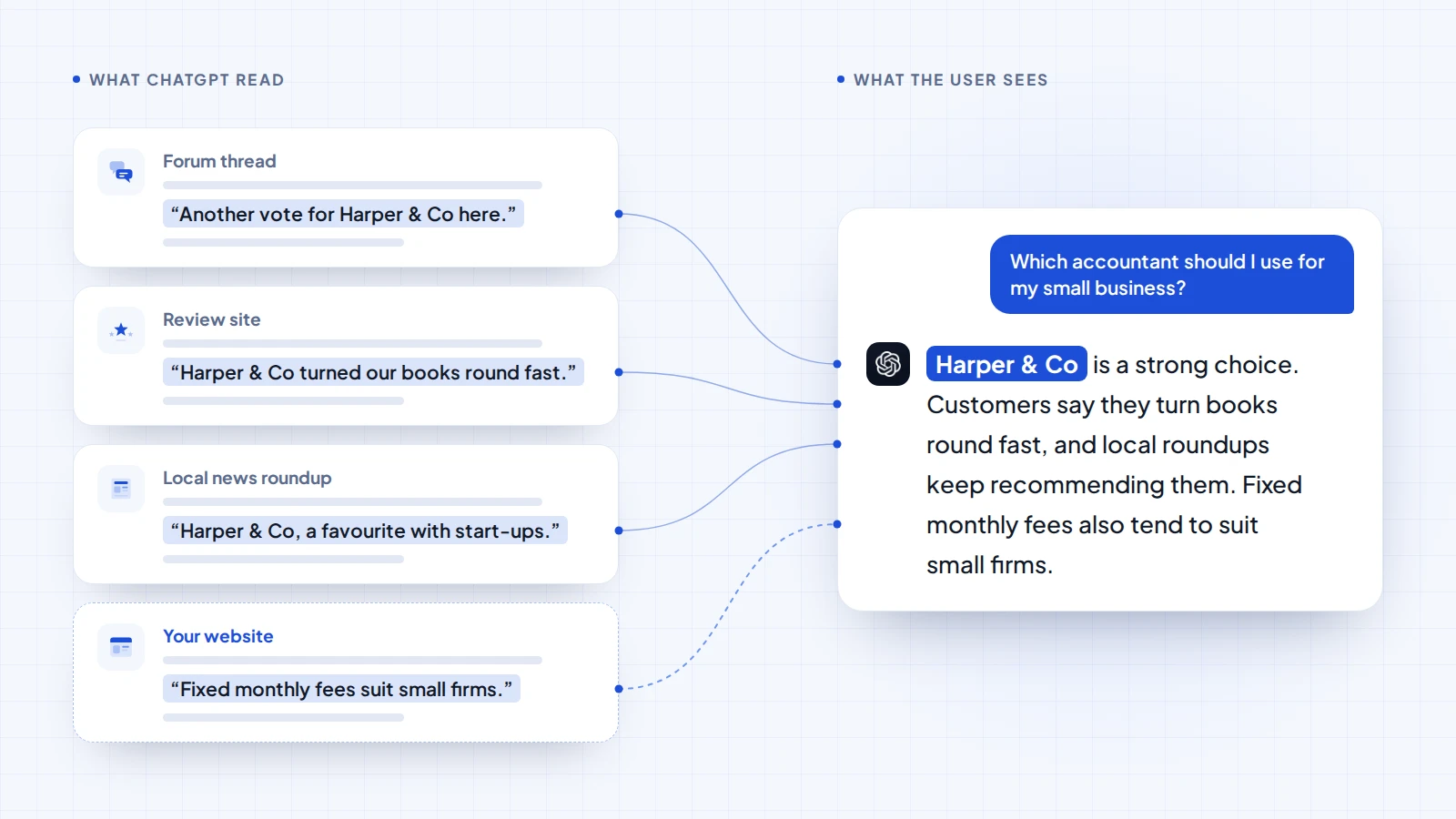
So there are two stages. You want to be used as a source consistently, and what you provide has to be good enough for ChatGPT to name you as well.
Good SEO can help a lot here. Pages ranking first on Google get cited by ChatGPT a little over 40% of the time. But ranking isn't the core of it, and you don't need it. That's the big opportunity for smaller businesses that missed the SEO wave, maybe because the time or the know-how was never there. This is the chance to catch up and get recommended, through what's called GEO (generative engine optimisation) or AEO (answer engine optimisation), depending on which term you prefer.
Where should a business owner start?
Start with the basics, and be patient. Getting recommended won't happen overnight, but it needn't take as long as you might fear either. Get these few things right and you can make real headway.
- Make sure ChatGPT can read your site. Some web security services, Cloudflare among them, now keep certain AI bots out unless you tell them otherwise, particularly on sites newly added to Cloudflare that carry ads. On top of that, most AI tools can't see anything that only appears once JavaScript has loaded. You can ask an AI tool to look over your site for both, or bring in an agency that knows what to look for and have them get the foundations right.
- Describe your business the same way everywhere. Pick one clear sentence for what you do and use it across your whole site. If the way you describe yourself varies too much from page to page, ChatGPT can't work out what you actually do, and when it's that unclear, it won't use you as a source. It prefers clear, definite statements.
- Get other people talking about you. Much like SEO, it's worth finding ways onto other people's pages, whether that's a roundup post, someone else's blog, the press, a podcast or even YouTube. Any mention across the internet is a good thing. The difference is that you don't need a link this time: a mention on its own is enough for ChatGPT to pick up.
- Write about the oddly specific things you know. Remember those fan-out queries: ChatGPT runs several searches for every question, so narrow pieces on the details of your expertise, your product or your service can get picked up, even on topics people might never type into Google. They might not bring in much traffic, but that doesn't stop them being powerful pieces to have.
- Lead with the answer. Whatever you publish, get straight to the point. If the answer sits deep in an article, ChatGPT will skip it, so put it right at the top and let the detail follow.
- Ask new customers how they found you. Finally, close the loop. When someone becomes a customer, downloads something from you or signs up to your newsletter, ask how they heard about you, and include ChatGPT as one of the options. Over time, you'll see how many people it's sending your way.
Beyond these, there are plenty of tools that measure how often you're recommended, though they can feel a bit daunting. And all of this is really only the tip of the iceberg of a proper AEO strategy.
What's a waste of your time or money?
If you've started looking into this, you may have come across a few things we'd steer you away from:
- llms.txt, a file some agencies add to your site for AI tools to read. Google says its search ignores the file, and OpenAI hasn't said ChatGPT's search reads it. It's a common misconception that setting one up will get you cited faster.
- Adding schema code to get cited. Schema is code that labels what's on a page for search engines. The evidence behind it isn't strong, and it shouldn't be your focus.
- 3,000-word guides. Length on its own won't get you cited. Pages that answer one question precisely tend to do better than long guides, and plenty of the pages AI tools cite come in under 1,000 words. This is where AEO diverges from what traditional SEO experts are used to.
- A "top 10 best" list with your competitors at the top. If you publish your own list for your niche, be careful what goes first, because ChatGPT tends to favour whatever comes first. List your competitors there and you're more or less giving it away to them.
- Checking if you're being recommended once, then leaving it. AI citations change every day, so leaving this for weeks or months at a time will hurt you in the long run. Ideally, someone is on top of it every day, making sure you're cited for the right things, adjusting your approach when it needs adjusting and keeping your content current.
That ongoing work is where a specialist AEO agency is worth having. But if an agency promises you a guaranteed recommendation, steer clear, because that isn't possible.
Callum is a marketing and ops leader who has built and scaled multichannel campaigns generating over $10m in ARR across international markets. He is the systems architect behind every Trigger AI build, turning strategy into automations that actually run.